

I can’t believe it, but in less than 2 weeks—I head West for my Mt. Baker climb.
Ready or not…here I come!
Mt. Baker is a glaciated active volcano and stands at 10,781 feet (3,286 meters) in the Pacific Northwest.
This is another peak I’ve attempted before, but was unable to summit due to 60 mph wind gusts.
After my first Rainier trip in 2014—climbing with friends, not official guides—I was scared witless. In hindsight, it was probably not the safest thing for the newbs (me) or my friends.
At the recommendation of my wise friend, Dan, I signed up for a 7 day mountaineering course on Mt. Baker in 2015.


I was totally geeking out about mountaineering circa 2015-2016!
So.
It’s been 11 years and I figured I’d give myself another shot at a Baker summit. I know, I know…summits aren’t everything.
But they sure are sweet.
If it happens, great. If not, that’s okay too. I’ll still be unplugged, backpacking in the beautiful wilderness.
That mindset—the wilderness itself being the reward—is only possible because of the preparation beforehand.
It’s been a minute since I’ve written a practical post.
I’ve been swimming in the deep end for weeks, excavating truths and untruths on Mt. Rainier. If you missed it, here’s the braided essay from last week:

But this week, I thought I’d share something lighter and practical—know your mountain.
Know Your Mountain
Not all hikes are created equal.
Ten miles in the desert is different than 10 miles through a boulder field is different than 10 miles on a glacier is different than 10 miles in the Great Smoky Mountain National Park.
Your training depends on the type of mountain you want to climb, so first, let’s get to know your hike.
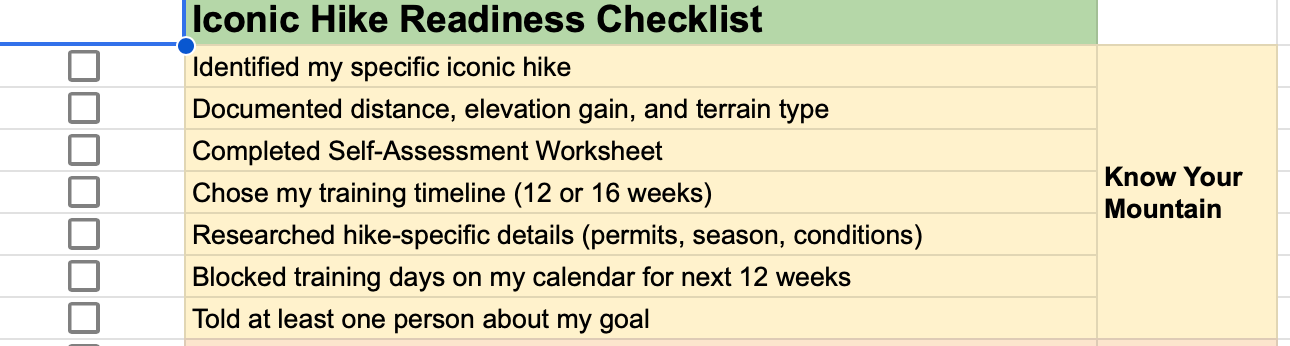
Four Factors That Define Every Hike
Distance - determines endurance needs and fueling strategy
Elevation gain (and loss) - determines your leg strength, pacing strategy, recovery needs. Note: Downhill is often harder on your body than uphill.
Terrain type - the surface - smooth trail, rock scrambles, loose scree, exposed ridgelines. This determines balance, footwork, and mental requirements.
Weather / Season - determines hydrating strategy and clothing requirements
For example: Rim-to-Rim Grand Canyon
Distance: 21-24 miles (depending on route)
Elevation: ~5700’ descent; ~6,000’ gain
Terrain: Well-maintained, relentless
Key Challenge: Descending first, then climbing out. Heat.
Training focus: Downhill quad strength, sustained effort over 10+ hours; heat acclimation
Strategy: Avoid Box Canyon in high heat
Blogs, National Park websites, AllTrails App, Google or AI search, maps -research multiple ways to learn about your hike.
What hike have you been dreaming about?
Tour du Mt. Blanc, John Muir Trail, W or O Trek in Patagonia, and maybe Annapurna Circuit are on my Thrive List.
What’s on yours? Hit reply and let me know.
Next week, we’ll get into an honest self-assessment so you have a solid awareness of where/how to begin training.
See you on the trails,
Haley + Fitz
I agree, summits are not everything but the reward at the top is sweet. It sounds like you are doing what you need to do to make it happen! Mother Nature sometimes has other ideas but going in prepared physically and mentally is all you can do. I'm heading up Mt. Katahdin this summer. It's one of those that definitely needs preparation, very technical and weather can be tricky in Maine. I wish you the best on your summit!!